How to clean a ceiling fan safely
Switch the fan off at the wall, use a stable step stool or an extendable duster, slip an old pillowcase over each blade, and wipe the rest with a damp cloth.
By the HomeMaster team · · 5 min read
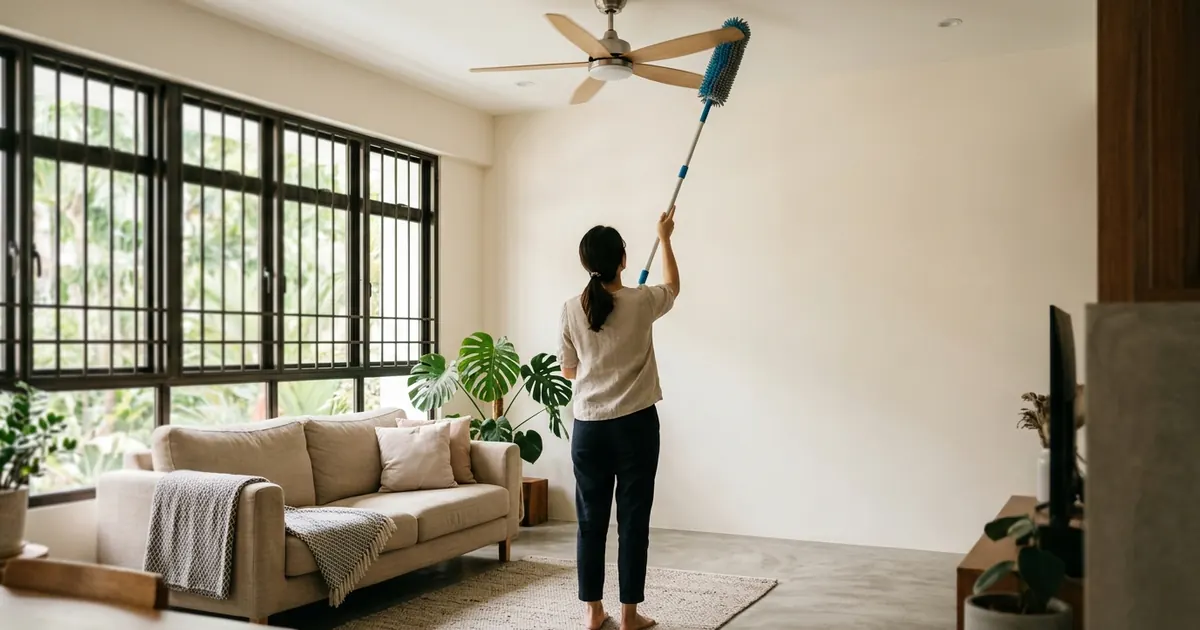
To clean a ceiling fan, switch it off at the wall, wait until the blades stop, and slide an old pillowcase over each blade in turn. Pull it back slowly so the dust stays inside the case rather than falling on the room below. Finish with a damp cloth on each blade and the motor housing. Use a stable step stool or a long-handled fan duster; never stand on a chair or a table.
Ceiling fans run for hours every day in most Singapore homes, and they collect a surprising amount of dust on the leading edge of each blade. Left long enough, that dust flies off every time the fan starts. Here is how to clean one safely, how often, and what to do about the sticky film that builds up near a kitchen. Fan blades are also dusted on every regular home cleaning visit, from floor level with an extendable duster.
Safety first
Most of the risk in cleaning a ceiling fan is the climb, not the cleaning.
- Switch it off at the wall switch, not just with the remote, and wait until the blades have stopped completely.
- Use a proper step stool with a wide top step, on a flat floor. A chair can tip, a table can wobble, and a sofa arm gives way.
- Do not overreach. Climb down and move the stool rather than leaning out to reach the far blade.
- Keep the fan still. Hold each blade gently while you wipe it. Pressing hard can bend a blade and make the fan wobble when it runs.
- Someone at the bottom helps, to hold the stool and pass things up.
If your ceiling is high and you cannot reach comfortably from a step stool, an extendable fan duster lets you do the job from the floor. Fittings that need a ladder are worth leaving for someone used to working at height.
How to clean a ceiling fan, step by step
What you need
- An old pillowcase
- A microfibre cloth, slightly damp
- A dry cloth
- An extendable fan duster, if the fan is out of reach
- Warm water with a little dishwashing liquid, for a greasy fan
- A step stool
Lay an old sheet or newspaper on the bed or sofa under the fan if you want to be safe.
The steps
- Switch off and wait until the blades stop.
- Bag each blade. Slip the pillowcase over a blade right up to the motor, press gently on the top and bottom, and pull it slowly back towards you. The dust stays inside. Shake the pillowcase out outdoors or into a bin bag afterwards.
- Wipe each blade with the damp microfibre cloth, top and underside. The leading edge, which cuts through the air, is usually the dirtiest.
- Dry each blade with the dry cloth so no water marks are left.
- Wipe the motor housing and the down rod with the damp cloth. Do not spray anything into the motor or onto any light fitting.
- Wipe the light cover, if the fan has one. Glass covers can be taken down once cool and washed in warm soapy water, then dried fully before refitting.
- Vacuum the room last, since some dust always escapes.
Kitchen, standing and wall fans
Greasy fans near the kitchen
A fan in an open kitchen or a dining area beside the stove picks up cooking oil from the air. Dust sticks to the oil and forms a grey, tacky film that a dry duster just smears.
For this, wipe each blade with a cloth dipped in warm water and a little dishwashing liquid, wrung out well so it does not drip. Go over it again with a cloth dampened in clean water, then dry. A degreaser can be used for heavy build-up, sprayed onto the cloth rather than the fan, following its label. Run the cooker hood whenever you cook and the film builds up much more slowly.
Standing and wall fans
A standing fan collects dust on the front and back grilles as well as the blades. Unplug it, unclip the front grille, wipe the blades and both grilles with a damp cloth, dry them and reassemble. Most grilles can also be washed in the shower and left to dry fully.
How often to clean a ceiling fan
For a fan that runs most days, every two to four weeks is a reasonable rhythm. Some signs it needs doing sooner:
- You can see a line of dust on the leading edge of a blade from the floor.
- Dust or fluff drifts down when the fan starts.
- Someone in the home has a dust allergy. Our guide to dust mites and allergens explains why fans and aircon vents matter for allergies.
- The room is near the kitchen, a busy road or an often-open window.
Fan blades are also worth doing before a big clean, such as the one before Chinese New Year. Whatever falls off them then gets vacuumed up with everything else.
When a cleaner can help
Fan blades within reach are part of a normal home cleaning visit, alongside aircon vents, sockets and cables. Many cleaning services, ours included, keep cleaners working from floor level for safety, so a high ceiling fan is easiest to handle if you leave out an extendable duster. Our guide to what a home cleaner does covers the other jobs that need the right tool or a different trade.
How it works with HomeMaster
Fans appear twice in the written 75-point standard our cleaners work to. In bedrooms, standing and ceiling fan blades, aircon vents, sockets and cables should be free of dust. In the living and dining room, fan surfaces should be too. You can see every point on our home cleaning checklist.
If your fans are greasy or have not been dusted in a long time, tell Helen, our AI assistant on WhatsApp, and mention whether you have an extendable duster. It helps your cleaner plan the time, and the room below stays cleaner too.
Frequently asked questions
What is the easiest way to clean a ceiling fan?
Use an old pillowcase. Switch the fan off, slide the pillowcase over one blade, press gently and pull it back slowly so the dust stays inside. Repeat for each blade, then wipe them with a damp cloth. If you cannot reach safely from a step stool, use an extendable fan duster from the floor.
Can I clean a ceiling fan without a ladder?
Yes. An extendable fan duster, shaped to wrap around a blade, lets you clean most ceiling fans while standing on the floor. It will not shift a sticky, greasy film as well as a damp cloth, so for a fan near the kitchen you may still need a stable step stool now and then.
Why does my ceiling fan get dirty so fast?
The leading edge of each blade pushes through the air for hours a day, and dust settles on it. Near a kitchen, cooking oil in the air makes the dust stick. Running the cooker hood while you cook and dusting the blades every two to four weeks keeps it under control.
Need a hand at home?
Tell Helen what you need on WhatsApp. She replies with real open times and the exact price, GST included, and weekends cost the same as weekdays.